
Mobile Massage
Post-Flight Massage: Recovering From Travel Days
Hours in an airplane seat leave a specific pattern of stiffness. What an arrival-day massage at your hotel or home can do — and the jet-lag honesty most ads skip.
Published 6/28/2026· By Kristian Fennessy, CMT
Two things it does, one thing it doesn't
A massage on arrival day can do two things well: it eases the stiffness of hours folded into an airplane seat, and it may help you wind down for your first night's sleep. What it does not do is reset your circadian clock — no bodywork does — and we would rather draw that line clearly than sell you a "jet lag treatment."
With that line drawn, there is still a lot on the honest side of it.
What a long flight leaves behind
An airplane seat holds your hips at ninety degrees, your knees bent, and your neck tipped toward a screen for hours, while the cabin air runs remarkably dry, typically 10 to 20 percent humidity by CDC figures. The result is a specific, recognizable pattern: hip flexors so shortened that standing fully upright at baggage claim feels strange, a stiff neck and upper back, ankles puffy from stillness, dry eyes and throat, and a nervous system that has been low-grade alert since the security line.
This is compression and stillness rather than injury, and it tends to respond well to exactly what massage is — sustained pressure, guided movement, and an hour in which your only job is to lie down.
One caution before anything else. If a leg is swollen, warm, red, or painful on one side after a long flight, call a doctor promptly and skip the massage. The CDC notes that anyone traveling more than four hours can be at some risk of a blood clot, though the risk is generally small, and massage over a suspected clot is a contraindication. Chest pain or sudden shortness of breath is an emergency.
Jet lag, honestly
Your body clock shifts about an hour a day after flying east and about an hour and a half after flying west, according to CDC travel guidance, and it responds mainly to light and to your sleep and meal schedule, not to bodywork. Any marketing that implies a massage resets your rhythm is overreaching, and we won't do it.
Here is what massage can reasonably contribute: the first night. Plenty of travelers sleep badly that night thanks to a wound-up nervous system and an unfamiliar bed, and a rough first night makes the next day of adjustment harder. An evening session may help you downshift before bed; studies in several patient groups link massage with better self-reported sleep, though travelers themselves haven't been studied. We went deeper on that mechanism in massage and sleep quality.
Timing it: arrival night or next morning
If you land by late afternoon, the same evening is the premium slot — settled in by six, on the table by eight, asleep by ten. Our hours run 7 am to 10 pm daily, which is forgiving of flight schedules.
For late-night arrivals, resist the urge to force it. Book the next morning instead: the session undoes the seat, and then you walk out into San Diego daylight. Light, unlike massage, actually moves your body clock; CDC guidance says morning light helps after flying east, while evening light helps after flying west. That pairing is about as close to honest jet lag support as bodywork gets.
How an arrival-day session works
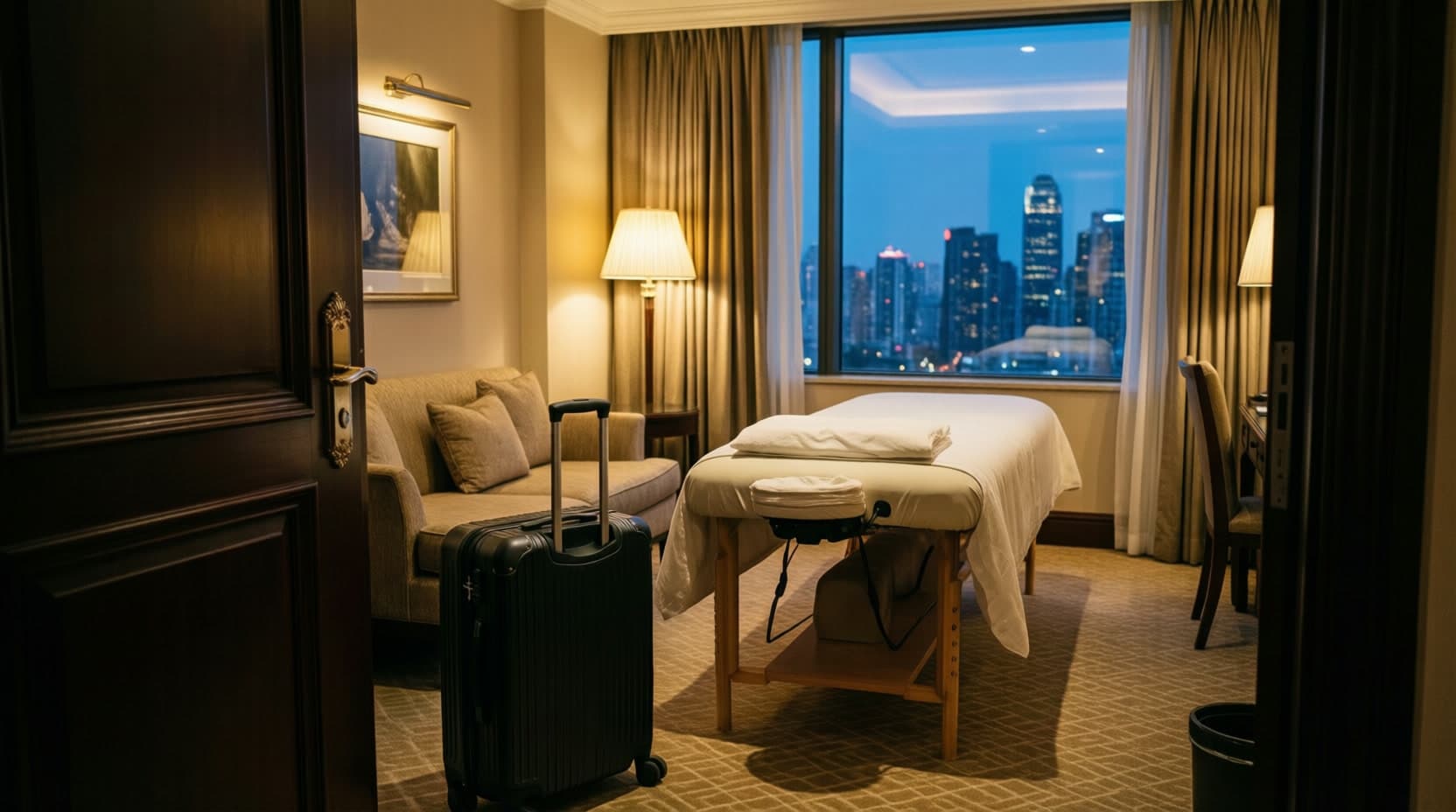
We bring everything — table, fresh linens, lotions, music — to your hotel room, vacation rental, or home. The setup needs a clear space of about seven by nine feet, which most hotel rooms manage once a luggage rack moves, and takes about ten minutes. We wrote a full logistics walkthrough in hotel and vacation rental massage in San Diego, including the front-desk and Airbnb-host details people ask about.
Booking happens online with live availability, and we confirm each request personally — there is no phone tag, which travelers in the wrong time zone tend to appreciate. We cover all of San Diego County: travel is free in Point Loma and Ocean Beach, $20 within the city of San Diego, and $40 elsewhere in the county, with neighborhoods listed on the service areas page.
What to book after a flight
For most arrivals, sixty minutes of Swedish work at moderate pressure is the right call — enough to address the neck, hips, and low back without demanding much of a body that spent all day in transit. If firm work is what your body knows, deep tissue is fine; put water in yourself through the afternoon first.
Ninety minutes earns its keep on the longest itineraries — international arrivals, or the red-eye-plus-connection days when the neck, hips, calves, and feet all have complaints worth hearing. Sixty runs $129 and ninety runs $179, plus the travel fee where one applies.
For the frequent flyer
If travel is your job rather than your vacation, the arrival-day session works better as a standing habit than a one-off rescue. The consultants and sales folks we work with tend to land at the same times on the same days, and a recurring slot the evening they get home does double duty: it undoes the week's seats and marks a clean boundary between the trip and the weekend. Booking ahead also solves the practical problem that prime evening slots go first — you can reserve the landing-day session before you even pack.
One more travel-specific note: the work we do on frequent flyers concentrates in the neck, the hip flexors, and — no one ever expects this — the forearms and hands, worn down by a week of laptops, roller bags, and phones. Bodies keep honest records of how they are used.
Ready to book?
Book your mobile massage onlineQuestions
Frequently asked
Keep reading
Related articles
Ready to book?
We bring the table, linens, and calm — you keep the couch afterward.