
Mobile Massage
What to Wear During a Massage: Draping, Explained
Undress to your comfort level — that's the entire rule. Here's what draping actually means, what most clients choose, and how privacy works when the session is in your own home.
Published 1/18/2026· By Kristian Fennessy, CMT
Undress to your comfort level, and know that you'll be covered by a sheet the entire session except the one area being worked on at that moment. That's the complete answer — everything below is just the detail that makes first-timers comfortable enough to believe it.
We're writing this because it is, by a wide margin, the question behind the question. When someone books a first session and asks about parking or timing or "anything I should know," what they often want to ask is: what am I supposed to wear, and how exposed am I going to be? Fair questions. Here are direct answers.
What draping actually means
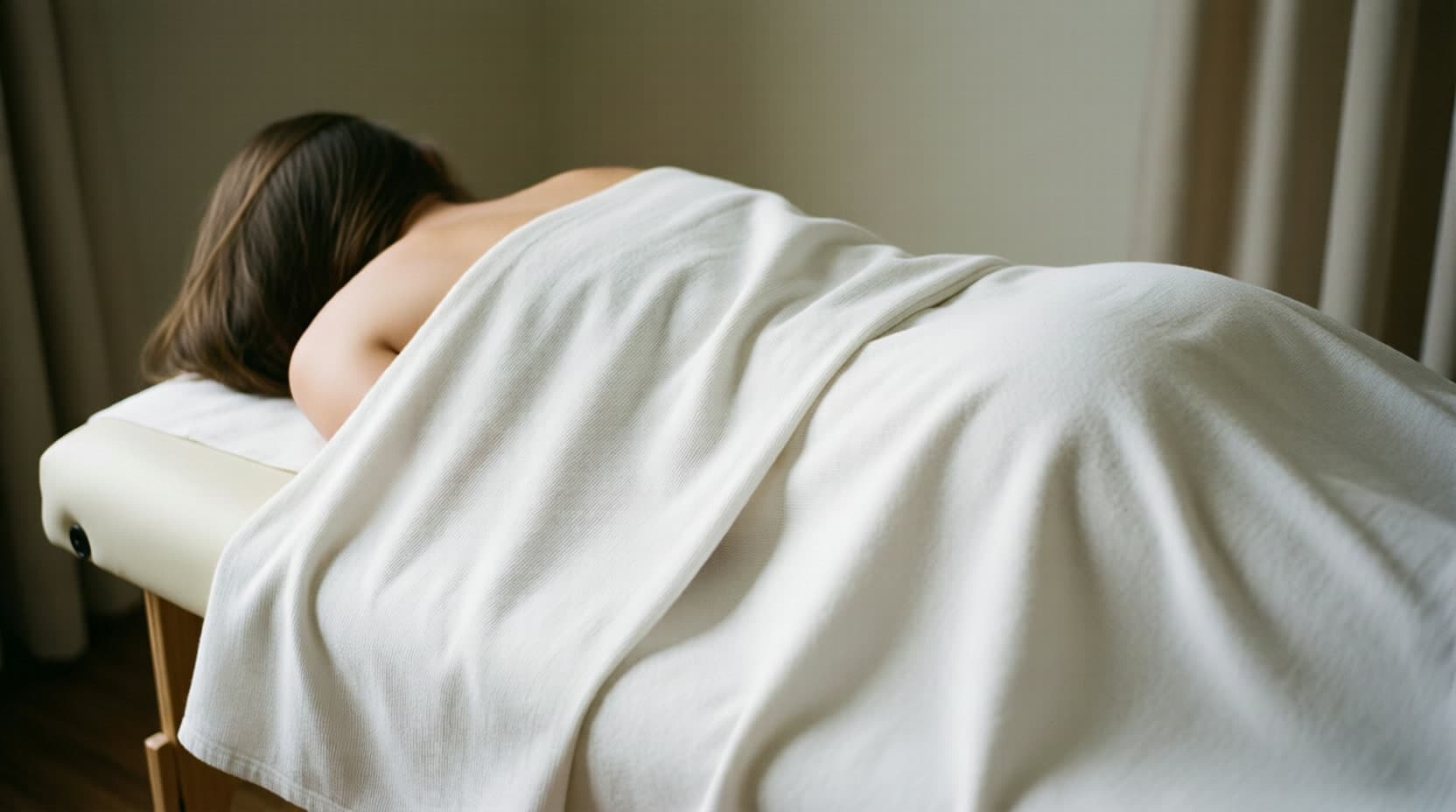
Draping is the professional standard that makes massage work. You lie on the table under a top sheet (and a blanket, if you run cold). When your therapist works on your back, the sheet is folded down to expose your back. When they work on a leg, that leg is uncovered and secured, and the rest of you stays wrapped. When they move to a new area, the previous one is covered first.
At no point are you lying exposed on a table. At no point is the sheet "optional." Draping is not a courtesy you have to request. Every session runs this way, with every client. Client draping is part of the hands-on training CAMTC requires of approved massage schools, and the ABMP Code of Ethics our therapists follow as members calls for "appropriate and skilled draping procedures." You can also look up a therapist's CAMTC certificate yourself at camtc.org, so you don't have to take a stranger's word for their credentials.
What most clients actually choose
Since "comfort level" is doing a lot of work in that first sentence, here's the honest distribution. Most clients undress fully or down to underwear. The practical reason: long, connected strokes up the back and legs — the backbone of a Swedish massage — work best on skin, and waistbands interrupt work on the lower back and hips, which is where many people carry the most tension.
Plenty of clients keep underwear on, and some keep more. Athletic shorts and a sports bra work fine. We've done effective sessions through clothing for clients who preferred it — the techniques shift toward compression and stretching rather than gliding strokes, and the session is still worthwhile.
Two things we want first-timers to hear plainly. Your choice will not be questioned or commented on. And nothing about your choice is unusual — after years of practice, we can tell you there is no "normal" everyone else is doing that you're deviating from.
How it works in your own home
In-home massage adds a wrinkle spas don't have: there's no changing room, because the changing room is your bedroom or hallway. Here's the sequence, so nothing is a surprise.
Your therapist arrives with the table, fresh linens, and everything else, and sets up in whatever space works — living rooms are most common; about 7 by 9 feet of clear floor is plenty. While the table goes up, you do whatever you like; this takes a few minutes. When it's ready, your therapist steps out of the room entirely (kitchen, hallway, patio) while you undress and get under the top sheet, then checks that you're settled before coming back in. At the end, the same thing in reverse: they leave the room, you get up and dress at your own pace.
If anything about the setup would make you more comfortable — a different room, a specific door closed, your partner home during the session — say so when booking or when we arrive. It's your house. We've answered more first-timer logistics in the FAQ and in a full walkthrough of what to expect from a first mobile massage.
You're in charge for the whole hour
Draping is really one piece of a bigger norm worth stating outright: consent in professional massage is continuous, not a box checked at the start. The ABMP Code of Ethics puts it plainly: therapists respect "the client's right to decline, modify, or stop the massage/bodywork session regardless of any prior consent they've given."
That means you can ask for anything to change mid-session and it will, immediately and without friction. Lighter pressure. Skipping an area entirely — feet, face, abdomen, anywhere. More blanket. Less conversation. A pause. Ending early. You don't need a diplomatic phrasing or a reason; "can we skip the neck today" is a complete sentence, and one we hear regularly.
Some clients worry that adjusting things insults the therapist. It's the opposite. Feedback is information, and a session tuned to what you actually want is the professional outcome, not a compromise of it.
One practical note for before we arrive
The clothes you wear to the session barely matter, since you'll change out of them in private — but loose, easy layers make the after easier. Post-massage, most people would rather pull on sweatpants than negotiate skinny jeans with freshly relaxed arms. If we've used lotion on your neck or shoulders, you may also want something you don't mind a trace of it touching. That's genuinely the only wardrobe planning the whole experience requires.
Ready to book?
Book your mobile massage onlineQuestions
Frequently asked
Keep reading
Related articles
Ready to book?
We bring the table, linens, and calm — you keep the couch afterward.