
Pain Relief
Massage for Tension Headaches: The Neck and Jaw Link
The band-around-the-head ache often starts below the skull — in the suboccipitals, the jaw, and the posture screens pull us into. Massage aimed there may reduce how often it shows up.
Published 3/1/2026· By Kristian Fennessy, CMT
The headache that starts below the skull
Most of the tension headaches we see in practice seem to involve more than the head: a handful of muscles at the base of the skull, in the jaw, and across the shoulders can be tender and reproduce the ache when pressed. Massage aimed at those specific muscles may reduce how often the headaches arrive and how hard they land, though it's honest support rather than treatment, and some headaches need a doctor before they need a therapist.
If you know the feeling — the tight band across the forehead, the pressure behind one eye, the ache that builds through an afternoon of screen work — the useful question isn't "why does my head hurt" but "what below my head is producing this."
Three culprits we check first
The suboccipitals
Four small muscles link the top two vertebrae and the base of the skull, and they help make the fine adjustments to head position. Hold your head still and slightly forward for eight hours of screen focus and they keep working. Tender spots here are commonly described as referring pain in a signature pattern: wrapping from the back of the skull over the top of the head, often settling behind an eye. Clients regularly describe that pattern as "my headache" before we've said a word.
The jaw
The masseter — the thick muscle that closes your jaw and powers your bite — sits at the angle of the jaw, and the temporalis fans wide across the temples. Clench through stressful meetings, or grind at night, and both spend hours doing isometric work no one designed them for. Temple headaches, and especially headaches you wake up with, can trace here. Grinding and clenching usually happen without your awareness, especially during sleep; most clenchers have no idea they clench until the muscle is pressed and the familiar ache answers.
The posture feeding both
Forward head posture is the multiplier. The further your head drifts toward a screen, the harder the muscles holding it up have to work, so the upper trapezius and levator scapulae spend the workday hauling on the neck like guy-wires. This is the same pattern we unpacked in the post on tech neck, and it's why a headache-focused session never stays confined to the head: the shoulders are usually paying the bill.
What a headache-focused session looks like
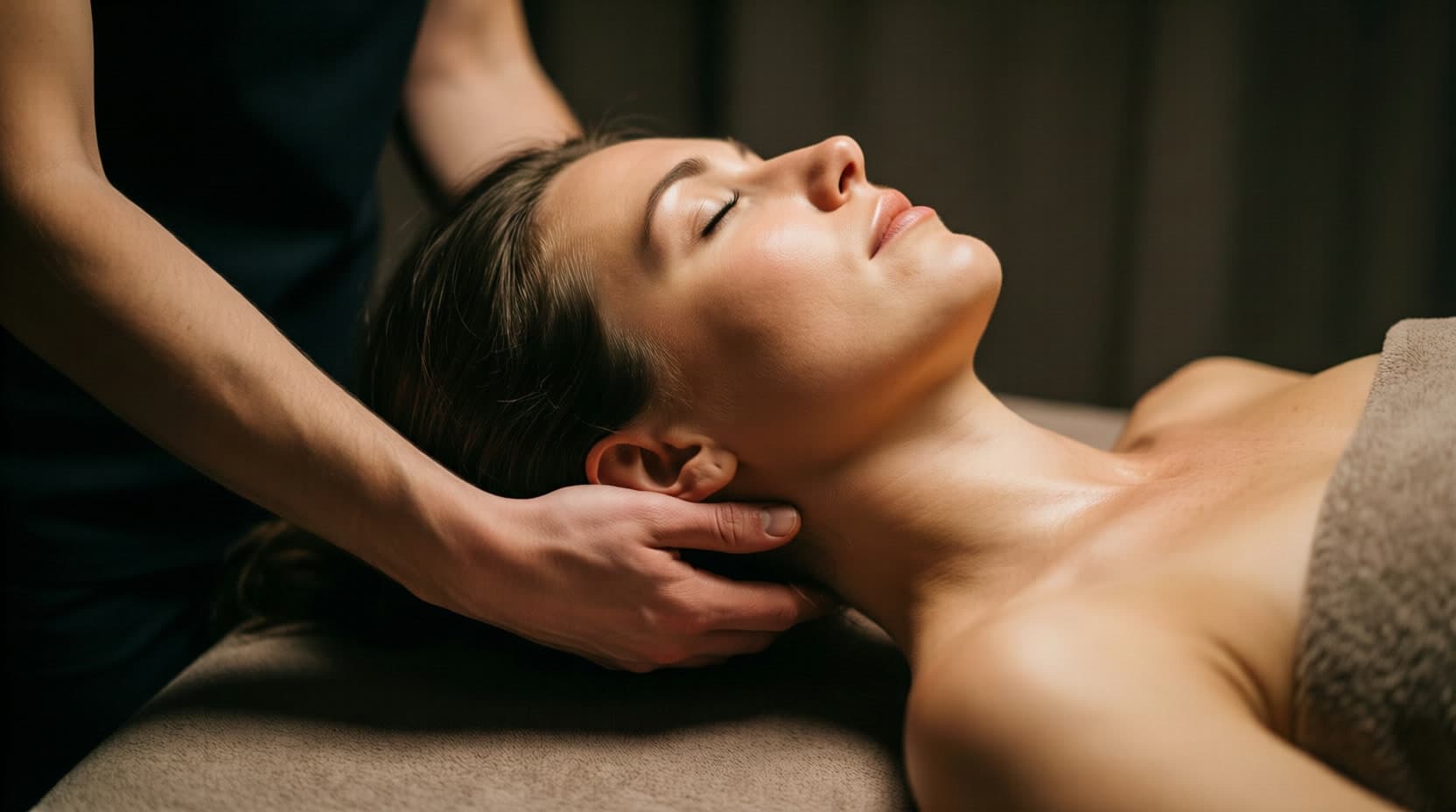
Different from a standard full-body hour. You'll spend more time face-up, because that's how we reach the front and sides of the neck properly. The suboccipital work is slow and unspectacular — fingertips settled at the base of the skull, sustained gentle pressure while the muscles decide to let go. Jaw work happens externally on the masseter and temporalis, always explained and agreed to first. The traps and levator get their share, and the scalp work at the end is more useful than it sounds.
Throughout, we're hunting for spots that reproduce your headache's shape — pressure that makes you say "that's it, that's the one" and then eases. That referral map is the same phenomenon covered in our trigger points post, where we also explain why the science behind it is debated. It's a practical guide to which muscles to spend time on for you specifically.
Having this done at home carries a quiet advantage: after intensive neck work, you want a dark, quiet room and no obligations — not a drive. An evening session that ends where you sleep pairs the work with rest, and rest is half the point. Sleep problems are a common tension headache trigger, according to the NHS, which is part of why the approach in our sleep post overlaps with this one.
Honest limits
Tension-type headaches are where massage has the most plausible role, and even there the right verbs are "may reduce" and "tends to help some people." A 2018 review of trigger point-focused manual therapy found it may reduce how often tension-type headaches occur, but rated the evidence very low quality. And in a 2015 randomized trial, trigger point massage and a sham treatment (switched-off ultrasound) both cut headache frequency, with no clear difference between them. That doesn't make the relief less real, but it does mean some of it may come from care and attention rather than anything specific in the technique. Migraine is a different animal — a neurological event, not a muscle problem. Some migraine sufferers find that keeping neck and shoulder tension low seems to help them overall; others can't bear touch during an episode. Massage does not treat migraine, and decisions about managing it belong with your doctor. There's also a middle category, headaches driven by neck joint irritation, where bodywork may ease the muscular overlay while the underlying diagnosis still needs clinical eyes.
If your headaches are frequent, changing, or eating painkillers by the handful — that last one matters, since overusing pain medication can itself perpetuate headaches — see a doctor before you see us. We'd rather be the second appointment.
When a headache needs a doctor, not a massage
A sudden, explosive, worst-of-your-life headache; a headache with fever and a stiff neck; a headache after any blow to the head; a headache arriving with confusion, vision changes, weakness, or slurred speech — every one of these means emergency care, today, no table involved. Less urgently: a new headache pattern that starts after age 50, headaches that wake you from sleep, headaches triggered by coughing or bending, or headaches steadily worsening over weeks all deserve a medical appointment before a massage one.
Between sessions
The homework is small. Raise the screen so the top of it sits at or slightly below eye level, so your head doesn't drift forward to meet it. Build a jaw check-in habit: teeth apart, lips together, tongue resting on the roof of the mouth; set a reminder if you need one. And if morning temple headaches are your pattern, mention grinding to your dentist — a night guard is a common dental option, and jaw-focused massage can sit alongside it.
Ready to book?
Evening appointments — the kind you can sleep right after — run until 10pm daily.
Book your mobile massage onlineQuestions
Frequently asked
Keep reading
Related articles
Ready to book?
We bring the table, linens, and calm — you keep the couch afterward.