
Pain Relief
Sciatica or Piriformis? What Massage Can Do for Leg Pain
Pain shooting down the back of your leg has two commonly discussed sources — an irritated nerve root at the spine, or a tight piriformis muscle in the hip. Massage may help one more than the other.
Published 2/15/2026· By Kristian Fennessy, CMT
One symptom, two very different sources
Pain that shoots from one buttock down the back of the leg is often blamed on one of two places: an irritated nerve root at the lumbar spine — true sciatica — or a tight piriformis muscle irritating the sciatic nerve deep in the hip. Massage cannot fix the first, but it may help the second, and telling them apart is where any honest conversation about bodywork for leg pain has to start.
We see this pattern constantly, in office workers who sit all day and in runners who ramped mileage too fast. The leg symptoms can feel nearly identical. The sources are not.
True sciatica starts at the spine
"Sciatica" properly describes irritation of a nerve root where it exits the lumbar spine — most often from a bulging disc or a narrowed passage. Because the problem sits at the root, symptoms often travel the nerve's full territory: pain, tingling, or numbness that may reach below the knee into the calf or foot, sometimes worsened by coughing, bending forward, or long sitting. Sorting out which structure is responsible takes a clinical exam, and sometimes imaging. That work belongs to a doctor or physical therapist, not to us.
Piriformis syndrome starts in the hip
The piriformis is a small, deep muscle running from the sacrum to the top of the femur, and the sciatic nerve usually passes directly beneath it; in roughly one in six people, according to a meta-analysis of cadaver studies, part or all of the nerve runs through or above it instead. When the piriformis tightens or spasms, it may press on the nerve and mimic sciatica closely. Piriformis syndrome is itself a debated diagnosis, with no agreed test, which is one more reason to get a clinical opinion. The tell is often location and trigger: pain that centers in the buttock, flares with long sits and car rides, and eases when you move around. Desk workers and drivers get it from compression; runners get it from overload.
Where massage genuinely helps
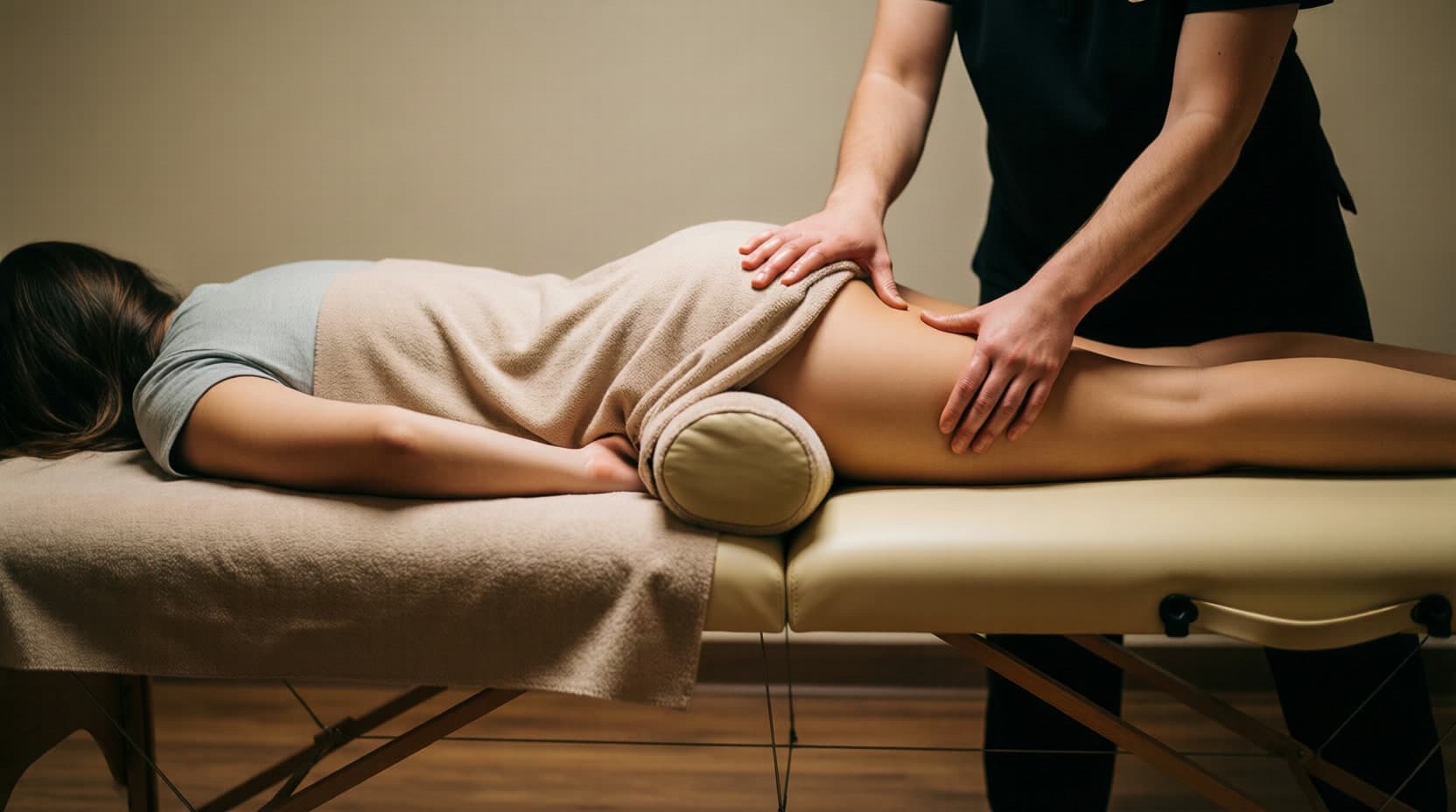
The piriformis is muscle, and muscle is our territory. Slow, sustained pressure into the deep hip rotators and the glutes above them may help a tight piriformis ease, which in theory takes pressure off the nerve underneath. Good trials of massage for piriformis syndrome are scarce, so treat this as a reasonable thing to try rather than a proven fix. Much of this work targets the taut, irritable spots that refer pain along predictable paths — the mechanics we covered in our post on trigger points — and a focused deep tissue session reaches them layer by layer rather than by force.
Even when the true source is spinal, massage has a supporting role. A body in nerve pain guards: the low back tightens, the hamstrings shorten, the opposite hip starts compensating. Releasing that secondary layer will not decompress a nerve root, but it may reduce the total amount of pain you are carrying and make the medical treatment you're receiving easier to live with. That matches UK guidance from NICE, which suggests considering soft tissue techniques such as massage for low back pain with or without sciatica, but only as part of a treatment package that includes exercise.
What massage cannot do
It cannot shrink a disc bulge, widen a narrowed foramen, or change any structure of the spine. A therapist who promises to fix your sciatica with massage is telling you something about their honesty, not their skill. The defensible claim is smaller: massage may relieve muscle-driven leg pain, and may ease the muscular overlay on nerve-driven pain, as a complement to medical care — never as a replacement for it.
See a doctor first if any of these are true
Some presentations need medicine before they need a table.
Go to the emergency room or call 911 now if you have numbness around your genitals or bottom, new trouble controlling your bladder or bowels, sciatica in both legs, or weakness or numbness in both legs that is severe or getting worse. These can be signs of cauda equina syndrome, a compressed bundle of nerves at the base of the spine that needs emergency care.
Book a medical visit — not a massage — if you have:
- weakness in one leg or foot, or a foot that has started to slap or drag
- leg pain that began after a fall, accident, or other trauma
- pain accompanied by fever, unexplained weight loss, or a history of cancer
- symptoms that haven't improved after a few weeks, are getting worse, or stop you doing normal activities
None of these are common. All of them matter more than anything we can do with our hands.
What a session for this actually looks like
The piriformis lies beneath the largest muscle in the body, so reaching it is gradual: warming the glutes and low back first, then sinking in slowly while you breathe. You stay in charge of depth. The sensation we're looking for is the familiar ache — "that's it, that's my spot" — never a sharpening or spreading of the shooting pain. If pressure makes symptoms travel further down the leg, we back off and work elsewhere; that response is useful information about what's driving things.
We'll usually also spend time on the hamstrings, hip flexors, and low back, because none of these patterns exists in isolation. And because the session happens at your home, you skip folding yourself into a car seat immediately afterward, which is the kind of long sit that tends to aggravate a cranky piriformis. For how to space follow-up sessions, our massage frequency guide covers the honest math.
Between sessions
Sitting is usually the aggravator, so the homework is unglamorous. Take the wallet out of your back pocket for good. Break up long drives — and long Netflix stretches — regularly, even just to stand. A gentle figure-four stretch can help if it stays comfortable; stop if it sharpens the leg symptoms rather than easing the hip.
Ready to book?
Book your mobile massage onlineQuestions
Frequently asked
Keep reading
Related articles
Ready to book?
We bring the table, linens, and calm — you keep the couch afterward.